The Way of the Dragon Heart
LongXinDao seeks a meeting between Chinese internal practice and Japanese budō. Chen Si Gong supplies the movement vocabulary; Cheng Hsin examines balance and u…
Read the essay →ATENA DOJO · LIBRARY
We begin with the spiral movement of Chen Si Gong, examine the body unity taught by Cheng Hsin, and approach modern ninjutsu as a wider field of skills and judgment.
LongXinDao seeks a meeting between Chinese internal practice and Japanese budō. Chen Si Gong supplies the movement vocabulary; Cheng Hsin examines balance and u…
Read the essay →
Internal practice is not the absence of muscular effort. In the Chinese traditions, neijia describes a historical family of martial arts, while neigong refers t…
Read the essay →
Silk-reeling is not decorative arm circling. Its useful lesson is the continuous relationship between the feet, pelvis, trunk and hands. Even a straight-looking…
Read the essay →
Peter Ralston's Cheng Hsin invites practitioners to examine centering, grounding, whole-body connection, relaxation and calm. Relaxation does not mean abandonin…
Read the essay →
Koichi Tohei's four principles provide a language for focused, calm movement: keep one point, relax completely, keep weight underside and extend ki. LongXinDao …
Read the essay →
A calm body is useful only if calm can survive movement. LongXinDao separates three tasks: discovering an attentive bodily state, maintaining coordination while…
Read the essay →
A new style deserves its own name only if it answers a clear question better than simply studying its sources side by side. LongXinDao therefore needs compariso…
Read the essay →
Experience can improve timing, judgment and economy of movement, even as maximal strength and speed tend to decline with age. LongXinDao seeks a practice that r…
Read the essay →
The modern ninjutsu traditions offer more than empty-hand movement. Awareness, observation, tools, environmental judgment, strategy and historical martial cultu…
Read the essay →
A ninjutsu-style turn or change of angle need not become a large circular motion to benefit from silk-reeling principles. The question is whether the feet, pelv…
Read the essay →
Wing Tsun contributes close-range awareness, the centerline idea, compact hand methods and sensitivity drills. LongXinDao would not copy its entire stance syste…
Read the essay →
The Wing Chun wooden dummy offers a consistent reference for distance, angle and body alignment. In LongXinDao it could support the study of spiral coordination…
Read the essay →
Chi Sau can develop sensitivity to changing pressure and direction at close distance. The skill is not predicting a compliant partner's routine; it is recognizi…
Read the essay →
Qinna studies grips, balance, joint mechanics and the management of contact. Dr. Yang Jwing-Ming's writings provide a systematic introduction. LongXinDao is int…
Read the essay →
Systema material associated with Ryabko and Vasiliev offers questions about breath, tension, contact and responding without rigid preparation. These are useful …
Read the essay →
Jeet Kune Do was not merely an unfinished syllabus. Bruce Lee deliberately questioned closed styles and urged direct experience, economical movement and adaptat…
Read the essay →
Any broad self-defense curriculum must account for loss of balance and contact with the ground. Judo, wrestling and Brazilian jiu-jitsu are valuable because the…
Read the essay →
A new martial art should not compare itself only with cooperative demonstrations. Sanda already combines Chinese striking and throws in regulated competition; M…
Read the essay →
Damo Mitchell's Dragon Dao Yin offers a way to explore spinal mobility, coordinated movement and attention within a Daoist training context. LongXinDao places i…
Read the essay →
The Root of Chinese Qigong introduces a broad conceptual map: history, jing, qi, shen, bodily regulation, breathing and the mind. It is especially valuable when…
Read the essay →
The names 'sinew transformation' and 'marrow washing' belong to a rich history of Chinese cultivation. Their movements and breathing practices can be examined f…
Read the essay →
Iron Shirt traditions differ considerably. Some emphasize posture and coordinated support; others include heavy impact conditioning. LongXinDao would explore th…
Read the essay →
The 'Yoga from a Pure Source' tradition draws on the eight limbs of yoga within a Vaishnava framework. Its ethical commitments, postures, breath and concentrati…
Read the essay →
Satyananda Saraswati's Yoga Nidra guides attention through the body, breath, sensations and imagery. It can provide a deliberate setting for noticing tension ra…
Read the essay →
The original Makkō-hō presents four accessible movements centered largely on the hips and lower body. It may complement yoga and more targeted stretching withou…
Read the essay →
Wei qi is a traditional Chinese concept of defensive vitality; the Wim Hof Method uses modern breathing exercises and cold exposure. Limited experiments have ob…
Read the essay →
Historical shinobi practice included deception and observation, but that does not establish modern indirect hypnosis as an ancient ninjutsu technique. Mentalism…
Read the essay →
Bruce Lee's training notes connect quick action with economy of preparation, alertness and purposeful footwork. A movement can carry power yet become too easy t…
Read the essay →
Mark Lauren's progressive bodyweight programs offer a practical foundation for pushing, pulling, squatting, hip control and trunk strength. For LongXinDao they …
Read the essay →
The Concept2 RowErg offers repeatable measures of distance, pace and training load. A session of twenty to thirty minutes can be useful when intensity and techn…
Read the essay →
A jump rope is simple, portable and demanding. It trains repeated foot contacts, rhythm and coordination, while imposing real load on the calves and Achilles te…
Read the essay →
Lucas Rockwood's Science of Stretching concentrates on targeted flexibility work. LongXinDao distinguishes passive range, active control and movement that remai…
Read the essay →
A kettlebell can develop strength, grip, trunk stability and the control of a moving external load. That makes it a possible complement to Chen Si Gong, not a r…
Read the essay →
A schedule fails when every attractive practice becomes another compulsory session. LongXinDao must balance technical training, bodyweight strength, aerobic wor…
Read the essay →
Sleep, light movement and planned rest are not signs of weak discipline. They allow demanding practice to become sustainable. Yoga Nidra may support relaxation …
Read the essay →
The weapons wing of Atena Dojo is about body coordination, historical literacy, responsibility and safety. Training sticks, wooden swords and inert knives can i…
Read the essay →
A staff and a wooden sword change leverage, reach and the weight felt in the hands. This makes them useful movement teachers. LongXinDao would ask whether Chen …
Read the essay →
Hyōhō Niten Ichi-ryū preserves training with one or two swords, commonly using a longer and a shorter weapon. For LongXinDao the most interesting question is no…
Read the essay →
An inert training knife may help students appreciate range, speed and the seriousness of sharp objects. It must never encourage confidence in effortless disarms…
Read the essay →
The proposed wooden 'dakra' resembles a short Japanese palm stick or yawara. Its name is an artistic reference, not evidence of historical continuity with a fic…
Read the essay →
Shuriken traditions include more than star-shaped throwing tools, but they should not be confused with unrestricted improvised-weapon use. LongXinDao is interes…
Read the essay →
An object that can be bought legally is not necessarily legal to carry in every public setting or to use in every encounter. Hungarian rules distinguish categor…
Read the essay →
Yip Man's influence on modern Wing Chun and on Bruce Lee is substantial, yet cinematic biographies add invented encounters and dramatic details. The familiar bo…
Read the essay →
Morihei Ueshiba founded aikido within a complex martial and spiritual history. Koichi Tohei later gave distinctive emphasis to mind–body unity and ki-developmen…
Read the essay →
Zen Body-Being asks practitioners to feel structure, alignment and effort directly rather than merely imitate an instructor's outer shape. LongXinDao can use it…
Read the essay →
Damo Mitchell's books and courses present neigong as a progressive practice with its own terminology and training order. LongXinDao can study this pedagogical s…
Read the essay →
The Art of War is a military classic, not a modern street-defense manual. Its enduring questions concern information, timing, risk and the cost of confrontation…
Read the essay →
Miyamoto Musashi's Book of Five Rings considers Earth, Water, Fire, Wind and Void as perspectives on strategy. LongXinDao may interpret them pedagogically as fo…
Read the essay →
Ashida Kim's The Invisible Fist can be read as a provocative reflection on attention, expectation and the myths surrounding ninja secrecy. Its claims should not…
Read the essay →
Bruce Lee valued rigorous repetition, footwork, strength and speed. The surviving writings and students' recollections reveal a practical worker rather than a m…
Read the essay →
Dim Mak literature blends traditional point maps, anatomical observations and extraordinary claims. These are different kinds of information. Nerves and vulnera…
Read the essay →
Scott Rogers' pressure-point teaching provides an identifiable source for studying Kyusho Jutsu. A video demonstration can illustrate a claim but cannot indepen…
Read the essay →
Materials published under the title Dim Mak Secrets contain claims about pressure points and unusual physiological effects. Before judging them, the exact autho…
Read the essay →
Mikhail Ryabko's Beyond the Physical material is associated with claims about subtle influence and responses with minimal or no contact. Such demonstrations inv…
Read the essay →
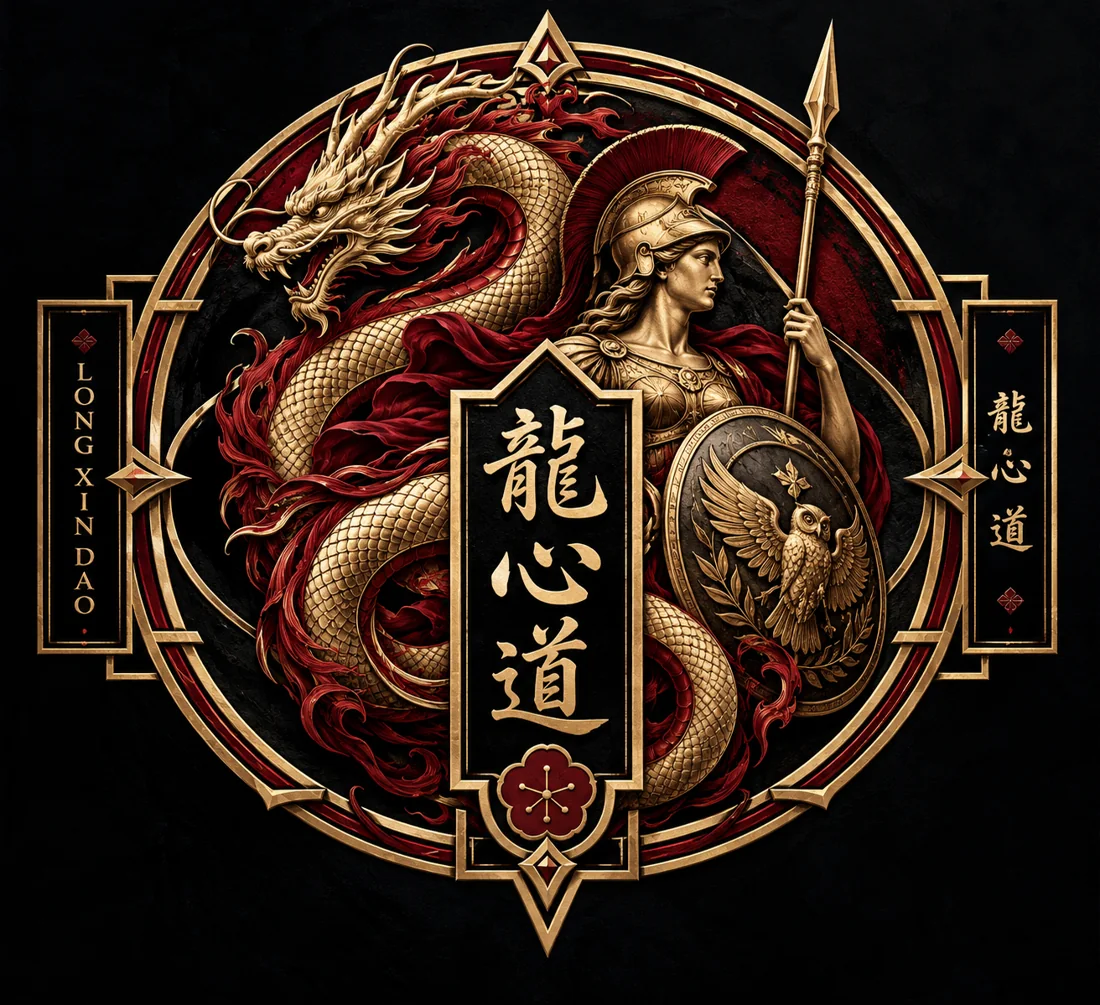
Athena is a fitting emblem for a martial education that values judgment over display. Courage without restraint can become recklessness; knowledge without respo…
Read the essay →
Studying a teacher, citing a book or linking to an organization does not create an official affiliation. LongXinDao respects source traditions while developing …
Read the essay →
Not fortune-telling, but a disciplined language for recognizing relationships, turning points and possible consequences.
Read the essay →
The trigrams are not personality types or fighting stances: they are perspectives for examining change.
Read the essay →
Each hexagram joins two trigrams, inviting us to consider interacting influences rather than a fixed future.
Read the essay →